

The Final Wilderness in Philadelphia Is Under Attack
Upper Roxborough is the last rural corner of Philadelphia, a place where forests and fields reign. Squeezed by development and climate change, how much longer can it last?
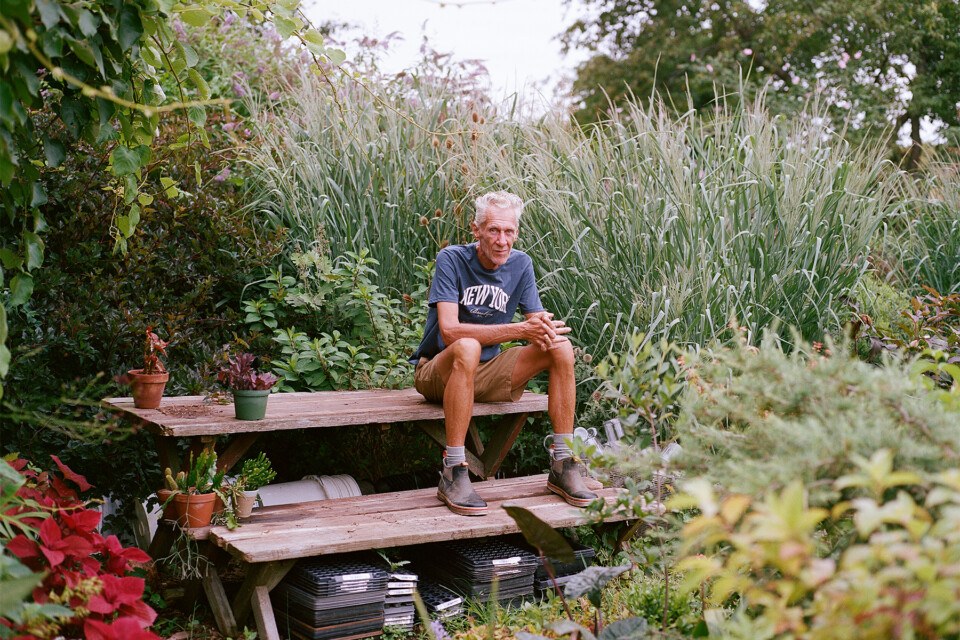
John Carson at Manatawna Farm in Upper Roxborough / Photography by Kit Ramsey
John Carson’s little spread at the Manatawna Farm community garden sits off a gravel road along the Philadelphia–Montgomery County line, in a place that looks frozen in time. On a day this summer, when sunshine and storm clouds battle overhead, the 68-year-old takes shelter from both underneath a patio umbrella, reclining in an Adirondack chair. Bees and butterflies flit between black-eyed Susans he planted nearby.
On the other side of a fence, a hayfield is rejuvenating between harvests. In the fall, bobolinks, majestic grassland birds, will stop there during their annual return to South America. Beyond the hayfield there’s an old farmhouse and barn, then another hayfield, then a powerline right-of-way, then the Schuylkill River, and rising beyond that, a thickly wooded hillside in Montgomery County.
Bending his tan, slender figure to fidget with a rock, Carson marvels that the city of Philadelphia still contains such a view. Then he wonders how much time it has left.
This little-traveled patch of Philadelphia is so separated from city life that it doesn’t even really have a name. Some call it Andorra; its civic organization goes by Shawmont Valley. Many locals simply tell people they live in Upper Roxborough, but that’s a name that extends to the busy thoroughfares of Ridge and Henry avenues, which feel a world away. Whatever one calls it, the land is a swath of roughly 700 rural acres boxed in between the river, Ridge Avenue, the county line, and Shawmont Avenue, a Roxborough roadway where the city’s manifest destiny seems to have curled up and died.
Indeed, that’s more or less what happened. Binney Meigs, a descendant of Philadelphia tycoon Henry H. Houston, says his great-grandfather owned this land and in the late 1800s intended to turn it into the next Chestnut Hill. But the landscape, littered with steep ravines, proved too tricky for train lines. Two generations later, after a proposal to build a highway bridging both the Schuylkill and Wissahickon valleys also failed, Houston’s heirs gave up the ghost on their inheritance. In 1965 they converted hundreds of wooded acres into what is now the Schuylkill Center for Environmental Education, one of the nation’s first urban preserves of its kind.
“They were all becoming more conservation-minded,” Meigs says of his parents’ and grandparents’ generations. “To develop [the land] would have been very costly and would have also been very destructive. And they loved the land.”
Sixty years later, the Schuylkill Center continues to manage 365 acres of protected woodland — the largest privately held open space in Philadelphia and the core of this backwoods enclave of Upper Roxborough. Surrounding the preserve are about the same number of low-density acres of various usages: a walking path, the working hayfields and gardens of Manatawna Farm, Lankenau Environmental Science High School, and secluded single-family properties, many large enough to run ATVs on.
Consult historical maps and the area looks little changed from centuries ago. In 1682, Philadelphia began as a little sliver along the Delaware River. Then it burst forth, chewing through swamps, farms, and country manors as it filled out what is now the city’s northeast, southwest, and northwest.
What’s left undeveloped today is mostly confined to the Fairmount Park system — which includes places like FDR Park and the Wissahickon Valley — and this far corner of Upper Roxborough. Here, there are just four main roads, one laid in gravel, slicing through the forests and fields. Many homes are on a combination of septic system and well water. It’s not unusual to see abandoned farmhouses and barns overtaken by vegetation, specters on a landscape that appears largely unchanging.
Look carefully, though, and one can see that it is not.
“There’s a massive pressure for change,” Carson says.
In a 1983 Inquirer article detailing city plans to purchase and protect open space, a city planner for the Northwest noted that Upper Roxborough was one of the few sections of the city that had experienced population growth over the prior decade. More than 80 acres had been lost to residential development, including the Green Tree Run condominiums, a 210-unit property built on 12 acres just off Shawmont Avenue.
“The pressures to develop Upper Roxborough have been mounting and can only get more intense,” the planner, Paul Curran, told the paper.
More recently, in 2010, came the Glen at Shawmont Station, an apartment complex that added 202 units on 18 acres next to the condos. A few years later, across Shawmont Avenue, a developer built townhomes for the first time on the western slopes of the actual Green Tree Run, a stream running in a steep ravine toward the Schuylkill River.
With just eight units, the development play was small, but neighbors cried foul anyway, warning of the degradation that would follow as developers crossed their Rubicon and began to creep toward the edges of the Schuylkill Center.
“Eventually constructions like this will destroy this whole valley,” Sheila D’Ambrosio, the founding president of the Residents of Shawmont Valley Association, told a reporter in 2012.
Since then, another developer has divided up what was once a wooded 10-acre parcel in the heart of the area into six luxury homes: one built, one under construction, the rest digital renderings awaiting a buyer.
Ask current residents whether they feel the area is at risk of development, and you get a mixed bag. RSVA president Aaron Couch doesn’t present with the same urgency as his predecessor. There is definitely development pressure in other parts of Roxborough, Couch says, but he feels that Shawmont Valley’s topography and mostly single-family zoning offer protection.
“We have steep slopes, and then Port Royal doesn’t even have its own sewage,” Couch says, referring to one of the area’s primary residential roadways. “It seems like the most popular type of development isn’t quite possible here.”
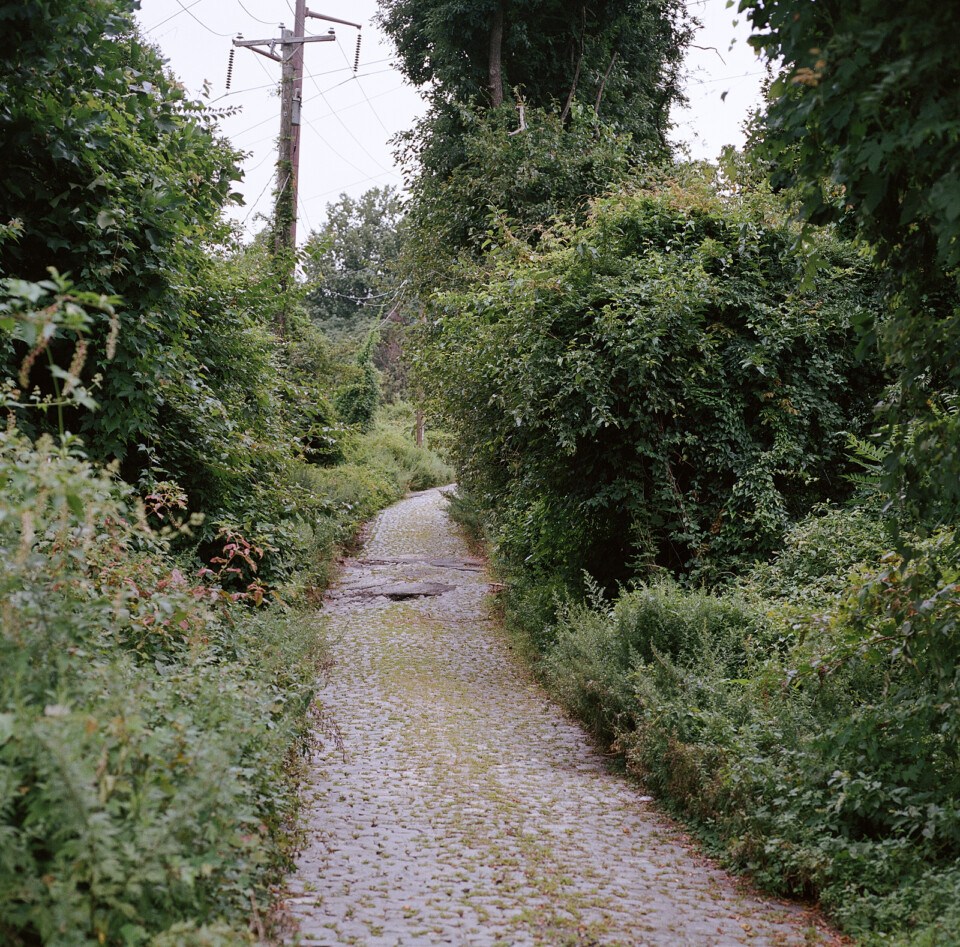
Port Royal Avenue in Shawmont Valley
Others aren’t so sure. Curtis Jones, the West Philadelphia–based city councilmember whose district takes an amusing leap across the Schuylkill River to ensnare this most rural corner of the city, says it’s only a prevent defense that is keeping developers at bay.
“They’ve been discovered in Upper Roxborough,” Jones says. “Everybody’s looking at every available lot to say, ‘Wouldn’t a nice group of condos look great there?’”
Development concerns in Upper Roxborough boiled over anew four years ago, when the Schuylkill Center proposed selling the “Boy Scout Tract,” a 24-acre parcel adjacent to its main holdings that had been used decades earlier as a Boy Scout campground. It took an 11th-hour donation of $3 million from wealthy benefactors to ward off a sale, and the tract was placed under a conservation easement and will remain wooded, even as it currently lacks a human use.
“Our duty as stewards is to engage with the earth sustainably, and sometimes, as in this case, not to engage at all but to act as guardians to preserve it as is,” Marilyn Tinari, president of the center’s board of trustees, explained to local media at the time.
But now the next crisis has arrived: Residents are battling with the School District of Philadelphia to remove Lankenau, a magnet school specializing in environmental science, from the planned school closure list. Originally, the district said it intended to sell the secluded 17-acre campus to develop affordable housing. That was until the Schuylkill Center, which had owned the land until 1973, dusted off a half-century-old deed restriction that it says grants a right of first refusal for any sale. What happens next remains up in the air.
Jones says he is aware of the need for more affordable housing in Philadelphia and supports Mayor Cherelle Parker’s initiative to secure 30,000 such units. But he says he quickly came to appreciate the aesthetic of this part of his district, and he has concerns about developing amid its steep topography. Other sections of the city, such as Hunting Park, West Philadelphia, and City Avenue, are better candidates, he says.
Amid the development tumult, another kind of threat made itself apparent this summer when a downed power line at the Schuylkill Center sparked a dangerous three-alarm wildfire near the visitor center. With no fire hydrants on site, the firefighters attempted to pump water out of a pond. When that failed, they considered forming a bucket brigade before a firefighter with experience fighting wildfires out West dug a trench line that helped extinguish the blaze.
Canadian wildfire smoke arrived a few weeks later and curtailed programming for the Schuylkill Center’s annual summer camp, and executive director Erin Mooney says the season proved eye-opening for the potential risks climate change will bring to the center’s acreage. Maintaining this land as an accessible place for Philadelphians to learn about and experience nature is already precarious financially, she says.
And how much more will survival cost during an impending era of floods and fires?
“I value the environment,” she says. “But I don’t have the personal funds to conserve this place. In America and other places around the world, we rely on wealth to help protect the environment. Does that work for the Schuylkill Center? Does that work for nature in Philadelphia?”
The short answer to Mooney’s questions is not really.
Despite its status as the linchpin of rural Upper Roxborough, the Schuylkill Center is stretched thin, usually operating in the red on a budget of about $3 million a year.
That has neighbors like Carson, the community gardener at Manatawna Farm, nervous; the farm on which the gardens sit is another historic hand-me-down from the Houston family. Meigs grew up there in a 19th-century farmhouse, shuffling off to Chestnut Hill Academy for school in the late 1960s in between chores on the gentleman’s farm.
“It was a fascinating and rare and bizarre thing to go to school in Chestnut Hill and then go home and milk cows or shovel out stalls,” Meigs says.
But the soil was poor and eventually the operation lost its charm, and his family divested the land to the Schuylkill Center as a kind of agricultural annex to its main acreage on the other side of Spring Lane. As it happened, the center quickly tired of the land too. Records show that it sold about 80 acres to the city of Philadelphia in the mid-1980s, including a 35-acre parcel on the other side of the county line in Whitemarsh Township.
A status quo emerged. Philadelphia Parks & Recreation managed Manatawna’s hayfields, from which hay is harvested for livestock at the Walter B. Saul agricultural high school, about three miles away. The Schuylkill Center leased and managed the five-acre, 300-plot community garden, where Carson and dozens of others grow food and flora. And the School District of Philadelphia operated Lankenau High School, which it originally bought in 1979, just north of Manatawna Farm, solidifying the low-density character of this westernmost flank of Upper Roxborough.
But change is now in the wind: In January, the district announced its intent to fold Lankenau’s programs into Saul and sell off the school, whose enrollment of 228 students (less than 50 percent of capacity), the district said, leaves the Lankenau building “severely underutilized.” The Schuylkill Center announced last year that it is exiting the Manatawna lease agreement, and Carson and his fellow gardeners worry the city could end up selling off the whole farm, which is valued at a combined $15 million.
Carson pegs much of this precarity to the Schuylkill Center’s decades of divestments. At one time the center owned 571 acres of land in Upper Roxborough, but it has since sold about a third, including Manatawna Farm, the Lankenau property, and at least 39 other acres to private developers or religious institutions.
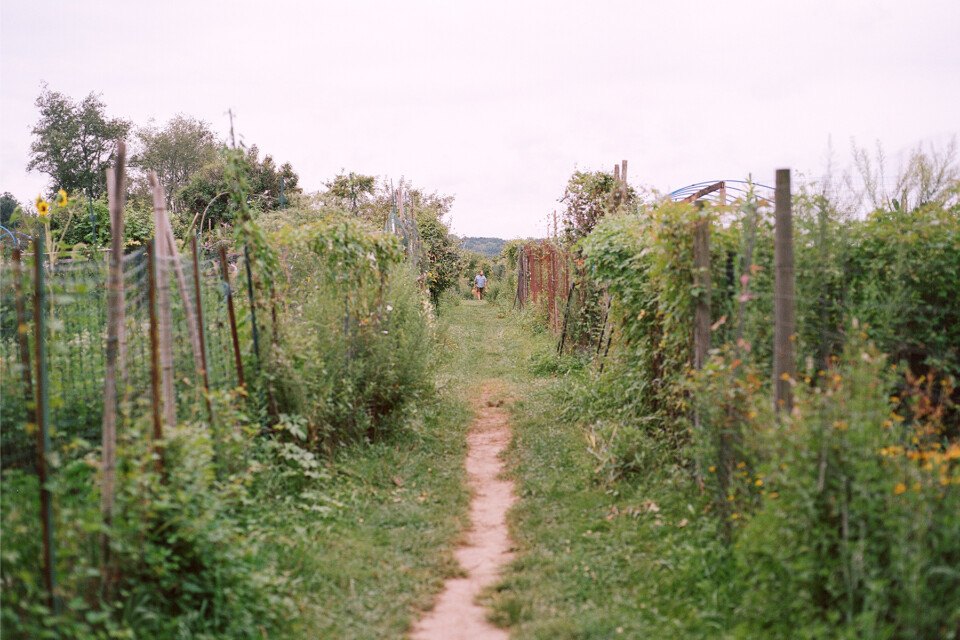
Walking the paths of Manatawna Farm
Of course, some of the transactions, like Lankenau, came with restrictions and have their own fair share of obstacles. Mooney, the Schuylkill Center’s executive director, says her organization would exercise its right of first refusal and buy back the 17-acre property if the school district attempts to go ahead with plans to sell it for further development. Councilman Jones is also working on a bill to convert the land’s zoning and formally restrict it from residential use, which he hopes to pass this fall. The district’s website currently says it will instead turn the property into an environmental education center, which Mooney likens to building a Dunkin’ Donuts next to a Starbucks. Residents remain hopeful that the decision to close the school will be reversed.
But other former Schuylkill Center parcels have no such deed restrictions, including the 80-some acres that make up Manatawna Farm. After the Schuylkill Center last year informed the community gardeners and the city that it would not renew its lease, Parks & Rec put out an RFP looking for a company or nonprofit to oversee the space. The gardeners worry that new management will be more restrictive and bigfoot their current system of self-government.
Or worse. Carson notes that more than half of the garden is in Whitemarsh, beyond the reach of Philadelphia zoning.
“Theoretically, if the city sold part of the land back to Whitemarsh, they could develop it,” Carson says.
He also worries about what’s to come for the Schuylkill Center. The Boy Scout Tract, he notes, was the last holding outside its core acreage. The $3 million donation to conserve the tract in 2023 buoyed the organization’s coffers. But what happens the next time it ends up too far in the red?
“They basically kept themselves running by selling the land,” Carson says. “Now they’re scrambling.”
During a breezy hike on the center’s nature trails, Mooney addresses its financial precarities coolly, pausing in between to admire finches and woodpeckers foraging for food on the landscape.
No doubt, like many nonprofits of its kind, the center has its challenges, she says. Its budget deficits make operations and maintenance a constant struggle. But, she adds unequivocally, the organization is not on the verge of collapse. She’s confident its donor network is strong enough to chip in for big-ticket items, like it did for the Boy Scout Tract — and the Lankenau property, too, if need be.
The center’s acreage is also permanently protected from development through a conservation easement, a backstop Mooney says is watertight, short of the U.S. government building a military base there via eminent domain.
What is at stake, Mooney says, are the Schuylkill Center’s twin missions of public engagement and land management. Alongside a trail near the visitor center, Mooney points out a plethora of invasive plant species that need culling. Next to them are tiny structures of twigs and moss — fantastical homes left behind after the center’s annual Fairy Fest. Further into the woods, deep in a gully, the steep trails are significantly eroded by stormwater runoff, a constant challenge for even well-funded park systems. But these trails wind through one of the most sylvan and serene landscapes the city has to offer, with nary a soul in sight, unless you count the red foxes.
The fairy folk don’t have enough coin to support all that, Mooney says. The center sees just 12,000 visitors a year, compared to more than two million in the Wissahickon Valley. Mooney is constantly thinking about how to bring more Philadelphians to the space and convert them into contributors. With a hint of exasperation she adds that the center doesn’t get a dime in regular funding from the city or state. Instead, staff chase one pot of money to the next: large grants if they can get them, hounding wealthy donors if they can’t.
Whatever happens on the farmland to the north and Upper Roxborough’s residential plots to the south, Mooney says, the center’s 365 acres will never be converted to condos. But whether it secures its potential as one of the city’s highest-quality forests, where schoolchildren learn about flora and fauna during summer camp, nature lovers seek out moths by moonlight, and middle-aged women cosplay as Tinker Bell on the weekends, is an open question.
“Fast-forward a hundred years, someone will [be here] listening to birds,” Mooney says. “My call to the state and city leaders is, stand up now, fund this now, so that we’re not in that place 50 years from now, 100 years from now, where this is just more overgrown and people were wishing something had been done about it.”
As it turns out, people and land-use debates aren’t the only threatening forces here. In an unfortunate irony, just down the hill from the Schuylkill Center and Manatawna Farm, nature is already working on reclaiming itself from mankind’s incursions.
Every few years during hurricane season, the Schuylkill River rises and spills its waters across River Road, the aptly named street sandwiched between the riverbank and the steep ravines that kept Henry Houston from running his train line. During the heaviest storms, the water reaches the homes beyond the road.
Steve Coyle can tell those stories firsthand. A Roxborough/Manayunk lifer, Coyle lives in a rented manufactured home, the last abode in Philadelphia before travelers dead-end at a locked gate at the county line. Like most of his neighbors, he’s got a dock on the Schuylkill, although unlike some, his setup lacks a tiki bar. But he does have a boat, which he regularly takes out to catch catfish and convene with neighbors, including those who live on the far bank in Montgomery County.
This river life suits Coyle, who lost his wife to colon cancer six years ago. He still finds joy in sportfishing and his trio of daughters, one of whom performs with Center City’s Irish Heritage Theater, where Coyle helps make stage props. His home on the river supports both interests. Sitting by his dock on the river, Coyle proudly scrolls through iPhone photos of the massive flatheads he’s landed. Later, he explains that he’s preparing a room in his home to welcome a loved one for an extended stay.
He even wears an eye patch, the result of an injury, and otherwise appears salty enough to serve as an extra in Pirates of the Caribbean. But as climate change fuels an increase in extreme rainfall and flooding across the Delaware Valley, his way of life is under threat.
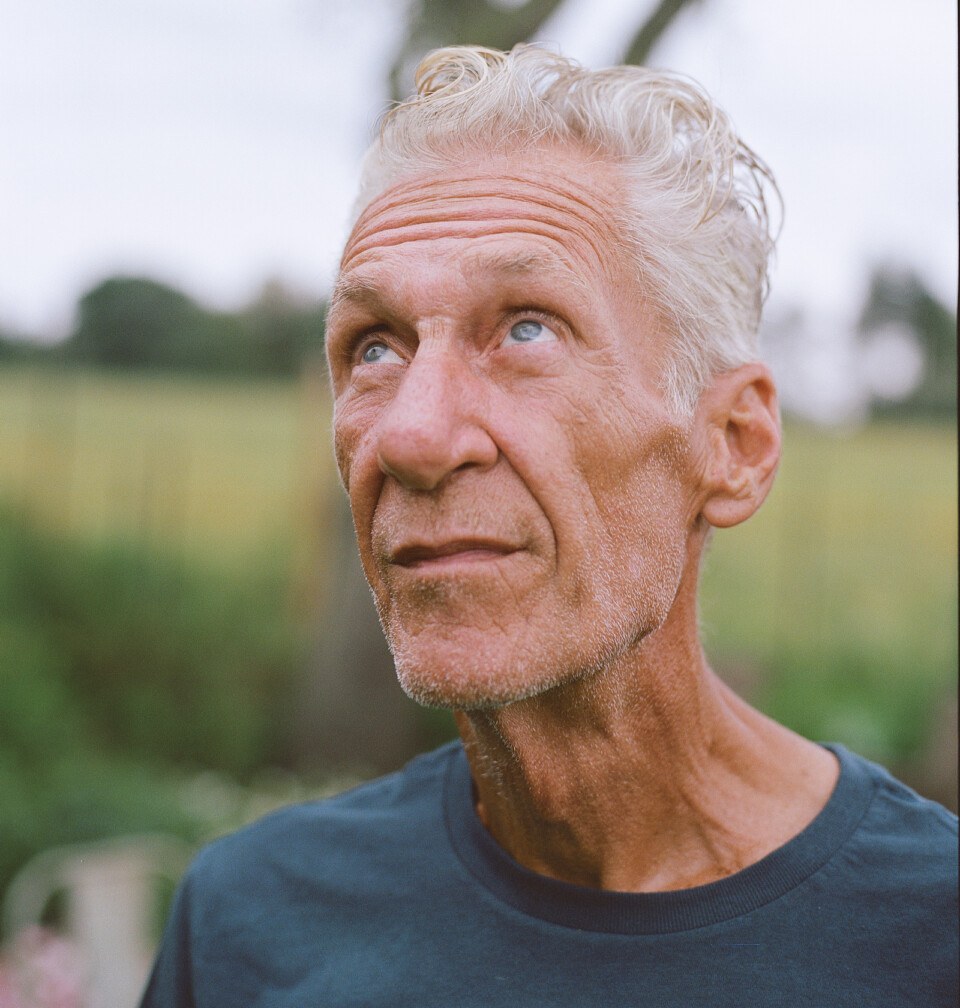
John Carson at Manatawna Farm
During Hurricane Ida in 2021, when the Schuylkill crested at historic heights, the river easily skipped up the few feet of embankment where Coyle’s dock stands, then made its way across the road, up a few more feet of concrete wall, and into his home. It got above his knees before he grabbed his daughter’s chinchilla in its cage, stuffed his anxious cat in a pillowcase, and used a plank to escape to elevated SEPTA tracks behind his home. Left behind and lost were many sentimental items, including photographs of his wife.
“It was a fucking nightmare,” he says.
River Road now has the look of a place enduring an uneven retreat. Newer, larger, shore house–style homes have elevated first floors, meant to lift them out of the reach of rising floodwaters. They stand next to smaller, older, simpler pads like Coyle’s that are far more vulnerable.
And the water will surely be back. Steve Goin, director of land and facilities at the Schuylkill Center, says there is already a noticeable uptick in extreme rain and stormwater runoff occurring in Upper Roxborough. The most recent evidence arrived this summer as the center was finishing up a $1 million project to install a boulder-lined channel to stop erosion on a steep hillside off Port Royal Avenue. The engineering work was supposed to see heavy use only during a 100-year storm, Goin says. But during a now-pedestrian rainstorm that hit as it neared completion, water was already roiling down the channel like rapids.
“One of the stats I heard is that Philadelphia has had a 300 percent increase in severe storms in just the last 10 years,” Goin says. “I’m thinking, does that mean I need three times as many water bars on the trail to avoid erosion? Does that mean I need to make my water bars three times bigger? As a land manager, I’m constantly assessing what has worked, what worked and maybe is now being overcome, and what needs to be done better.”
Coyle and his neighbors sit between these precipitous ravines uphill and the river — it’s water all the way down. Some have already moved on, like Coyle’s next-door neighbor, who bailed after Ida — her home swamped, condemned by the city, and torn down. It’s just one more of the thousand cuts slowly transforming Upper Roxborough, from the river to the ridge, one way or another.
After Ida, Coyle decided to stay, tearing out waterlogged drywall in his home, then building anew. He’ll be a holdout until the end.
“I love it down here so much, I’ll do it again,” he says.
Published as “The Final Wilderness” in the October 2026 issue of Philadelphia magazine.